Showing posts with label Weekend Updates. Show all posts

Monday, July 11, 2011

Putting Chicks Out on Pasture: Green Acres Weekend Update

Last week I blogged about moving the Cornish Cross broilers to their field pen.  Click here to read more about their adventure!  This week, in the midst of having the entire plumbing system replaced, a computer crashing, a two-day family getaway, fence building (Byron put in eight posts by hand one day last week!), picking wild blackberries, and waging continued warfare on squash bugs and their evil spawn, we also moved the Rhode Island Red chicks out on pasture!  They're four weeks old, and most of their adult feathers are in, which is apparently a sign that they're ready to explore the big world out there.


The hen house Byron built on an old trailer has been doubling as a brooder (he'll build a real brooder next year).  He hooked it up to the tractor...
 
...after a bit of rigging, due to shot hydraulics.  Better than spending hundreds on getting the hydraulics fixed...great job, Byron!
 
When he opened the door to the hen house this morning, they eyed the ramp suspiciously...

...so they got a little help flying the coop.

Exploring the big, green world...

...and looking more like chickens and less like little birds every day.

Breakfast buffet, with a bug or two on the side.  By the way, we're having to let the older hens, the Barred Rocks, free range so the little hens can have the protection of the electric fence.  We really hope the old girls don't fall prey to marauding animals, but until the Rhode Island Reds are bigger, we can't house them together since they could be injured by the bigger chickens.

And here are our Fat Boys (Cornish Cross) at their dinner buffet.  These boys are serious about their food; Byron's finger has almost fallen prey to their voracious appetites!  They are absolutely HUGE compared to the Rhode Island Reds, and this feed is non-GMO and free of hormones!

I'm linking again to Homestead Revival's Barn Hop.  Click below to join in!

Monday, July 4, 2011

Broiler Pens, Polyface-Style: Green Acres Weekend Update

You know how you start a project and convince yourself it will be done in an afternoon, and two days later you're still at it?  That's how our Polyface-style broiler pen project fared.  But it's done, and if we ever make another one, it probably will just take an afternoon!  Our pen was inspired by Joel Salatin's book, Pastured Poultry Profits, and images/instructions we found here on Flickr.  They are simple to make, pretty inexpensive (especially if you can score some extra metal roofing for free, which - darn it - we found out later we could have), and our Cornish-Cross meat birds are the fattest and happiest birds on the block.

The pen is 10'x12'x2' and can hold up to 100 broilers.  The people who posted the Flickr instructions used 1x4s for most of the frame, but we ripped 1x6s in half for the vertical and horizontal pieces, and in thirds for the diagonal braces, as Salatin recommends.  The bottom, horizontal board in the front and back is a 10' 2x4 ripped in half.

Framing done!

We salvaged the height-adjustable wheels from a spent lawn mower to help move the pen.  Salatin uses a special dolly.

We had to rig them a bit, but they work.

Finished!

Moving the broilers.  Salatin recommends doing this early in the day so they have time to acclimate before evening.  Our are almost three weeks old in this photo.

Pastured poultry!

We found four of these aluminum feeders, along with the old wooden poultry cage pictured above, in an antique shop.  They were reasonably priced, so we grabbed them.

We move the pen daily to new pasture, which provides fresh greens and bugs, and keeps conditions sanitary.

Here's our hallway...we're finally having our faulty plumbing replaced, so renovations are beginning again.
Happy Independence Day!

Monday, June 27, 2011

Me Versus the Pests: Green Acres Weekend Update

For the past two weeks, I've been waging some serious warfare against garden pests.  Since we're not using pesticides, the alternative is to spend time in the garden inspecting the plants and making sure they're not becoming breakfast/lunch/dinner/snack for various and sundry not-so-beneficial insects.  Here are a couple culprits I've battled so far:

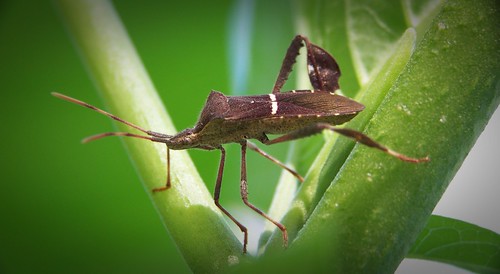
Squash Bug by whitney5544
Squash bugs hide under the leaves of squash plants (especially my cucumbers and zucchini), lay their tiny orange eggs on the tops and bottoms of the leaves, and suck the life out of the plants.  I picked these off by hand and dropped them into a coffee can filled with water.  I also scraped the eggs off the leaves and easily squished their evil spawn (which are tiny and white). 
(Photo credit:  whitney5544 on Flickr)
  
In early summer, squash bugs lay their eggs in neat groups directly onto the leaves of the plants.  The key to managing these pests is to destroy them early on, and to plant more than you need just in case you miss a few.  Once the plants get larger, they are much tougher to inspect for pests. 
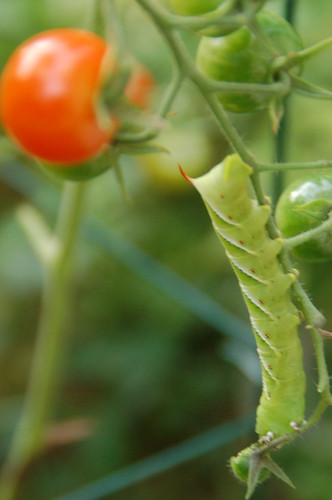
Another culprit I've found is the tomato hornworm.  Again, I just picked these off by hand, and they're not as prolific as the squash bugs.  A telltale sign of the tomato hornworm are missing leaves from your plants, and they blend in with the foliage very well, so you have to look for them carefully.  Here's a photo:

Tomato Hornworms by Clampants
(Photo credit:  Clampants on Flickr)
I didn't take photos, but I also picked off some red caterpillar-looking things on the apple trees.  For a spray, I tried combining 2 tbsp of Dr. Bronner's peppermint soap to a gallon of water, but I have yet to see the effectiveness of this method.  So the battle rages on...

Now for the weeds...

Monday, June 20, 2011

What I Would Ask Laura Ingalls Wilder: Green Acres Weekend Update

Our big dilemma this week has been when to wean our 6-week-old calves off milk replacer.  Last Saturday we took a 20+ mile drive out to a co-op to buy three more bags, and found that the price had gone up $12 per bag!  While we don't want to skimp and want to ensure that the calves get the protein they need, we also need to consider the financial viability of raising beef cattle in this manner.

From all the research we've done, the industry standard is to wean the calves at around six weeks.  By this time, the calves should have been on something called "calf starter," which is grain, and cheaper than milk replacer.  After they're weaned, their calf starter ration increases and continues until they're about six months old, at which time they're put on pasture.  The crux of this method seems to be the claim that the calf's rumen is not fully developed at birth, and they are therefore not able to get the nutrients they need from grass.

So the questions that remain are:
1. When is a cow's rumen "developed" enough to put them on pasture?  I couldn't find a definite answer anywhere.  Our calves have been eating grass since they were about two weeks old, and they're very healthy.
2. When can we wean them from milk replacer?  Cows are not designed to eat grain, so we're not going the route of calf starter.

In one of the Little House on the Prairie books, one of Laura's chores is to milk the cow and then reserve some of the milk to feed to the baby calf, who has been separated from the mother so that the family can have milk, too.  This is a method we are thinking of implementing at some point, but no one does this anymore.  Left with the mother, a calf might nurse for a year!  But how long did Laura go through this process?  I imagine they didn't feed the cows any grain back then, and cows can get protein from being on rotated pasture (another method used in the old days...in the form of picket lines instead of portable electric fencing).  It's unfortunate that these ways have been lost to current generations.  Since Laura and those of her generation have all passed, we feel that these methods need to be rediscovered by those of us without much experience or animal science degrees, but who believe that cows are designed to eat grass, not grain.

If anyone out there has been in our shoes, I'd love some advice!

This week we also completed the portable hen house, which we're currently using as a brooder:

At 4:00 a.m. Sunday morning, we discovered a couple roof leaks.  I picked up some metal roofing caulk yesterday, which we hope will remedy the problem.
Speaking of chicks, they are one week old now and are developing adult feathers and getting big, especially the Cornish Cross.  In fact, these meat birds are so lazy that they sometimes sit down while they eat!  We also think we found a nice home for Napoleon...we'll be transferring him to his final place of exile on Wednesday.  And despite the brooder lamp burning out sometime early this morning (always have an extra bulb or two!), we've only lost one Cornish Cross, who just dropped dead for no apparent reason the second day we had them.

This week I will try to sneak in a blog or two about the rain barrels.  We got 2.5" of rain the other night, which FILLED THE ENTIRE SYSTEM...220 GALLONS!  In fact, the intake barrel got so heavy that it tipped back against the house and I gave myself a nice slap on the hand for blowing off installing the overflow spout.

I've also spent some quality time trying to eradicate squash bugs and their evil little eggs in the garden...more on that later.

I'm linking up with Homestead Revival's Barn Hop...click the button below to check it out!

Monday, June 13, 2011

Our New Peeps: Green Acres Weekend Update

Sometimes we procrastinate because we want to.  At other times, because we have to.  We knew our new peeps (chicks) would be arriving this week, but amidst other projects we kept pushing the brooder/hen house aside.  So when we got an e-mail from the hatchery on Sunday, we dropped all other projects to prepare for our new arrivals.  Here's the play-by-play:

Sunday, June 12, 5:05 a.m.: E-mail sent from the hatchery to Byron, announcing that 73 chicks are coming SOON (like, tomorrow) to a post office near us.

Sunday, June 12, 10:00 a.m. - 9:00 p.m.: The nose-blowing and drilling commence.  Amidst a bad cold, Byron starts building a hen house/brooder for the chicks.  He gets the framing done and maybe one panel of the roof (thanks to our friend, Don, for the metal roofing)!

Sunday, June 12, 9:00 p.m.: Byron crashes and I start ripping apart cardboard to construct The Ultimate Indoor Jimmy-Rigged Brooder.  I also make sure the heat lamp works.

Monday, June 13, 6:00 a.m.: Byron's cell phone rings.  It's the post office asking us to rescue them from 73 annoying, peeping chicks.  Kidding, but not about who called.  Who knew the mailman got to work that early??

Monday, June 13, 8:35 a.m.: The kids and I pick up our new peeps.  Said peeps peck at me with their diminutive beaks from the holes in the box.  The kids can't get enough of that kind of naughtiness.

Monday, June 13, 8:45 a.m.: We get the chicks home, exile the cat from the house, and open the box.  Yup, everyone is alive.  The kids watch as I put the box of chicks under the heat lamp and take them out, one by one, to dip their beaks in water so they can get a drink.  The chicks then took it upon themselves to traipse about in the waterer and run up and down my legs.

Monday, June 13, sometime in the afternoon: Byron resumes work on the brooder/hen house. 

Monday, June 13, 6:00 p.m.: Neighbors visit the chicks.

Monday, June 13, 7:00 p.m.: Byron and Charlie go to collect river sand, which the chicks need for grit.  You can buy it at the store, but Joel Salatin says the real deal is better (and free).  And when it comes to all things chicken, he's the man.

Monday, June 13, 8:00 p.m.: I begin writing a blog post on the rain barrels.  Seriously.  It's there; I just need to add a couple more photos, spell check (because I'm a horrible speller/typist), and hit "publish." 

Monday, June 13, 11:24 p.m.: That would be now.  I decided I couldn't pass up blogging on our new arrivals.  These two-day-old chicks have mesmerized us all day with their chirping and antics, and it's been a fun experience for the kids. 


Cornish Cross...our 50 broilers.  I know, I've heard horror stories.  But we're going to try our hand at them and see how they do in a mobile coop.  Hopefully that will keep them from blimping out too much.

A Rhode Island Red sneaks into the photo.  We ordered 20 of these hens and one rooster, but they threw in an extra rooster for good measure.  Or maybe they thought we'd enjoy a good cock fight.

The little black chick with the yellow spot is Mystery Chicken.  Anyone know what kind of breed this is?  He/she/it is smaller than the others and seemed to be the runt at first.  But tonight it developed short man's (or woman's) complex and started pecking the other chicks.  If it's a boy, we're calling him Napoleon.

Chicks in the indoor brooder.  They'll be here for a couple days while Byron finishes the outdoor structure.  Here they're under the lamp, but we think they got a little too warm in the middle of the day because they were congregating near the walls.  I moved the lamp up an inch, and that seemed to help.

Am I telling this backward?  Here's the box they came in.

The Ultimate Indoor Jimmy-Rigged Brooder.  Notice the rounded corners; apparently 90 degree corners are a no-no because the chicks will swarm there and suffocate each other.  They're not the sharpest knives in the drawer.

Outdoor brooder/hen house.

Hopefully these will hold lots of eggs in the years to come!

Non-operable, chicken wire transoms around the top perimeter...for our high-class birds.
I hope to share with you what we learn as we raise our first batch of chicks.  And remember to click below and visit some other blogs on Homestead Revival's Barn Hop!

Monday, June 6, 2011

Hay Harvest Spring 2011: Green Acres Weekend Update

Last week may be a bit of a blur between the homeschooling seminar I had to attend for three days and the energy-sapping heat that made my spinach bolt early, but I do remember seeing hay.  Lots of it.  We've begun to stockpile bales since we'll have to feed two cows this winter.

The tricky part about acquiring hay these days is cost.  The equipment is light years out of our budget, and the going rate of $7 per bale is pretty steep for us, too.  So what is a wanna-be farmer to do?

One idea is to trade labor for hay by getting to know people in the area who cut hay.  For us, this was easy because Byron grew up around here and Melvin and Mr. Woodward are farmers who have been cutting hay on his family's property for years.  Every day after work this week, Byron would brave the ungodly temperatures and help Melvin by catching bales, stacking hay, hauling hay...in the process getting mauled by ticks.  We got 85 bales for his work.

Another thought is to let some of your grass grow for hay if you have the acreage, and pay someone to cut it for you.  We have 5 1/2 acres and let a little more than half of that grow.  Melvin has cut and baled most of it for us, and we have 75 bales so far!  I was astounded we got that many, and we agreed to pay Melvin about $2/bale.  Since hay will last a couple years, we'll have some extra just in case.

The first hay harvest was in exchange for labor.

You know it's hot when you have to rush your camera inside because the lens is fogging up!

Did you know hay can spontaneously combust?? Byron "stickered" the bales in an attempt to avoid this undesirable phenomenon.  So far, so good.

Melvin cut hay on our property (above), and a day or so later he raked it.

Raked hay.

Not sure of the official name, but this machine makes hay bales.

And this "machine" carries them...

...and stacks them.  With the help of farm muscles, of course.
I also managed to finish my first manifold rain barrel system!  I'll post on that soon!

Check out some other great blogs at Homestead Revival's Barn Hop!

Monday, May 23, 2011

A Special Visit and I Actually Design Something: Green Acres Weekend Update

First, let me say that many of the happenings last week deserve their own posts, and as long as I find an extra hour or five this week, more details will come.  The best way for me to handle this will be chronologically, and in photos, of course.

One of the cool things about homeschooling is the opportunity to ditch The Three R's for the day and take a field trip.   Another mom in our church graciously organized a zoo trip for over 100 homeschoolers, which meant that I got to spend the day asking my daughter the specifics on various and sundry vertebrates, because I'm a fun mom like that.  But after a while I gave up (or ran out of questions - I'm not a biologist) and started taking photos for a lap book we'll make.

Crowned Crane

Is the giraffe a staple of every zoo?
Next up: I got to be a stage mom.  Akea's dance recital was this week, which kept us busy with two rehearsals and two performances.  I was uncertain as to how much she liked dance up until now, but I think the recital won her over.  Or maybe it was getting flowers.  At any rate, on Friday night she intermittently would stop dancing, shade her eyes, and peer out into the audience, looking for us.  Fortunately, she had everyone rolling!


I think the fun costumes were a hit, too.
Finally, back at Green Acres, we got a lot of rain...and then it cleared up on Saturday just in time for a visit from Aunt Dottie, Uncle Hank, Byron's cousin Heinrich, his wife Donna, and his daughter Anna.  It's been a couple decades since any of them had been here, and they recalled how the farm used to look as we walked back toward the barn and before the guys disappeared into the woods...where Heinrich found his initials carved into a tree!  Aunt Dottie also got to again see the room she was born in, which is Charlie's room.  And they left us with this:


Byron's Great-Granddaddy gave this milk container to Aunt Dottie, his granddaughter.  We feel so honored that she and Uncle Hank have passed it on to us! 

Here we are...and this visit deserves - and will get - its own post!
Right now I'm going to let you in on a little secret.  I have that degree in architecture, right?  So I come up with all these cool design ideas for the house, right?  Um, not quite.  Since my brain has been rather preoccupied with children for the past almost seven years, Byron oftentimes comes up with and executes creative ideas in and out of the house.  Does this irk me to no end?  Sometimes.  But then every once in a while, my old muse remembers I exist and pays me a visit. 

First let me mention that with our animals, we are following the Polyface model of rotating birds (chickens) after herbivores (cows) in order to restore pasture, provide food in the form of larva for the chickens, and thus control said larva from hatching into flies.  Joel Salatin of Polyface explains this in great detail in his books, but he primarily follows patterns seen in nature and has been able to mitigate much disease and produce outstanding food.  Have you seen Food Inc.?  Cue it up on Netflix when you're done with this post and when you watch it, look for the part that features Salatin.  Even though we're on a MUCH smaller scale, we're following the Polyface model of using portable electric fencing to rotate our animals.

Since we have such young calves, we decided we needed a light, portable shade device that we could easily move from pasture to pasture.  After discussing various options, here's what I came up with:

Tarp over PVC anchored to bulky landscape ties = portable shade!
I'll share the design details in a post this week; it was very simple to construct!  I also worked a bit on those delinquent rain barrels.

And let's Barn Hop again at Homestead Revival!  Click the button below: