Showing posts with label Foraging. Show all posts

Thursday, December 8, 2011

Deck the Halls

I got a little carried away this morning as I was collecting cedar, holly, and pine to use at our homeschool group's Colonial Christmas party tomorrow (somehow I got volunteered to decorate).  Having just visited an historical Colonial home with my family this weekend, I was feeling inspired to try out some of the ridiculously simple and beautiful ideas in my home.  Here are the main players, all found on our property:
Holly.  Isn't it gorgeous?

Pine

Cedar
I'm no Martha Stewart, but for better or for worse, here's what I came up with:

Holly and cedar, tied together with ribbon from my neighbor (thanks, Julie!).  I made two, for either side of the fence as you enter the driveway.

Ribbon with cedar on either side of the door.

Bits of holly here and there.

A mason jar with holly and cedar, and a glass bowl with pine and pine cones.  I think mason jars make the coolest vases!

A bit of cedar and boxwood on the mantle.  I kept this low profile since we have a woodstove.  I'm also not sold on the vase, and am waiting for Byron to come home and offer his opinion (unlike many guys, he likes to have input in this department).
And here's another version.  Opinions, anyone?
Saturday update: added some ribbon.

Another update: decking out the wonderful milk can Aunt Dottie and Uncle Hank gave us.  This was actually used by Byron's great-grandfather. (Please excuse the painter's tape!  Renovations are still underway.)

This was my absolute favorite until I decked out the milk can: holly, boxwood, and ribbon.  I want to make 50 of them today so I can give one to everyone I know, but I have some other things I need to do.   
I will warn you that holly berries are toxic.  So if you have young kids, either put the fear of God in them regarding poisonous plants, have the number to Poison Control written on your palm at all times, or skip decking the halls with boughs of holly.  Personally, I prefer option one.

Do you have access to holly, cedar, and pine?  If not, find a friend who does!  It's free, sustainable, and makes storing at least some of your holiday decor a non-issue!

Thursday, February 10, 2011

Maple Madness

Last winter during the Snowpacolypse that pounded the southeast, Byron and I came up with a brilliant idea.  Why not make homemade maple syrup?  Grant you, not the kind you make from sugar, cornstarch, and whatnot.  I'm talking the real deal from our sugar maple tree that graces the front yard of Other House.  Yeah, we're hardcore like that.

This year, we sadly decided that we're way too busy with indoor and outdoor projects to tackle sugaring season, since making maple syrup does require a certain amount of dedication, ventilation, and insanity.  So since we won't be able to commit to the task, I wanted to write a post on the process for those of you who may want to give it a shot.  All we plan to do is tap our maples to see if we get any sap, since we're now in a slightly warmer part of the state and maples like a cooler climate and don't grow as well here.

Seriously, it's fun and relatively simple to make your own maple syrup.  Several types of maple trees exist, and the best for syrup-making are sugar maples.  Any type of maple can be tapped, however, and even hickories and walnut trees will produce sap that can be boiled down into syrup.  Sugar maples, however, tend to give you a better ratio of sap to syrup: 10 gallons of sap will yield one quart of syrup.  And I should mention that trees must be 10" in diameter in order to be tapped.  Our maple was pretty big, and we had three or four spiles in it.

Freezing temperatures at night that climb into the 40s and 50s during the day signal the beginning of sugaring season, since that's when the sap begins to flow inside the tree.  If you have a tree you'd like to tap, you'll need to order spiles, which are like little spouts, online (google "maple syrup equipment").  The rest of the "equipment" you probably have on hand: a drill, wire, milk jugs, tubing, a thermostat, canning jars, and BIG POTS. 


Step 1: Drill a hole, at a slight upward angle, 1½” into the tree and about three feet up from the ground.  Byron marked the 1 1/2" point on the drill bit with some painter's tape.

Step 2: Hammer the spile into the hole. This process does not hurt the tree; the hole will heal naturally after the season.

Step 3: Hang a clean milk jug from the spout to collect the sap. We took a spile to a hardware store and found some plastic tubing that fit snugly over it, and ran that into the cap of the milk jug.  And since we're classy like that, we just used some old wire to hang the jug from the spile.
Keep in mind that sap is perishable must be stored in the fridge and boiled down within a couple days. Choose a day that is relatively free of other activities, since you will need to add sap to the pot intermittently and will most likely not want to be testing out your first batch of syrup at 2 a.m. on a Sunday night.  And I'm speaking from experience!

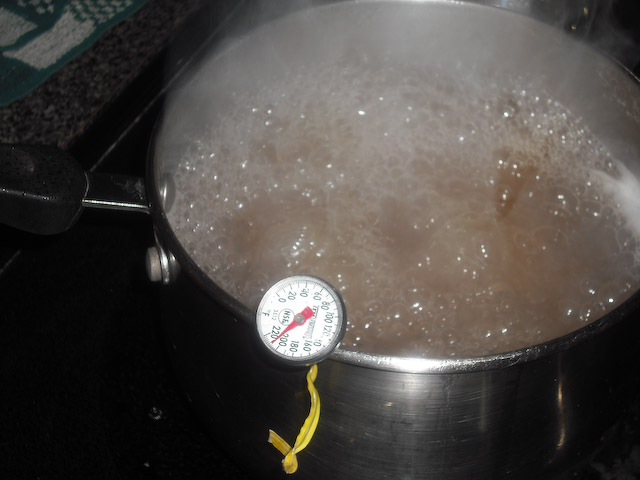
Most maple syrup producers recommend boiling sap outside because of the copious amounts of steam produced.  But at home, a large pot - or two, depending on the amount of sap you've collected - on the stove will do. Be sure to have decent ventilation. I'm not kidding; we had a fan blowing the steam toward an open window.

When you first get your sap boiling, you won't need to babysit it too closely.  You can check your e-mail, read a blog or two, sterilize your canning jars, etc. But as the sap boils down, you'll want to maybe combine sap if you have two pots going, then eventually transfer it to a smaller pot to prevent burning.  And because boiling points can vary due to altitude, take the temperature of your boiling sap when you begin.

We began with a pot or two like this...

...and ended up with syrup in a much smaller pot.
When the temperature of the sap reaches 7 degrees above boiling point, you have maple syrup! This part is both exciting and tricky because you need to be careful not to let it get too hot...then you'll end up with maple sugar. That may not be a bad thing, but it doesn't work too well on pancakes!


You'll need to filter your syrup into sterile canning jars immediately.  We found that a clean t-shirt, cut up into squares, worked best.  See?  I told you we're classy. 
Whatever you use to filter the syrup, you'll need several of.  We went through a few t-shirt squares each time because the pores of the cloth get clogged pretty quickly.

Our first two jars of maple syrup!  A lot of sugar settled on the bottom of the right-hand jar because we didn't know we needed a fresh bits of t-shirt the first time we filtered.  We ended up forcing a lot of the syrup - and consequently, sugar - through the already clogged pores of the cloth.  But it still tasted great.
Click here for a PDF we found to be helpful, and I'll answer any questions as best as I can.  Happy Sugaring Season...I miss it already!

Thursday, November 11, 2010

The (Wanna-Be) Farmers Must Be Crazy: Foraging Hay

This past summer the local newspaper did an article on us since they found it somewhat newsworthy that we bought this house and land back into the family and are trying to live more sustainably.  Of course, they wanted some quotes for the article, so they called a couple farmers we know in the area.  We suspected as much, but apparently the talk amongst the old-timers down at the corner store goes something like: "[Byron's] crazy for fooling with the farm now...They don't want  no cow!  They don't want no chickens!"  That's according to Mr. Woodward, a long-time farmer in the area who was friends with the Greens and is excited to see what we're doing here...he's even offered to help us choose a milk cow when the time comes.  I don't think Mr. Woodward thinks we're nuts, but I have a feeling he's been fielding some opinions from others in the area.  So with that reputation in mind, a few weeks ago Byron decided to forage hay.

We actually don't live in a dusty little corner of the county; we're a way back from the road but are still visible to passers-by.  So when Mr. Woodward's grandson cut the field by our house for hay, there were piles of the stuff still out there even after he baled it.  Well, when Byron saw that, he got about as excited about the loose hay as I did about the Autumn Berries.  He chose to make this a pre-dinner family adventure, which of course is right around the time when everyone else in the area is driving home from work.  The four of us were out there conspicuously raking hay into piles, and then Byron got a hold of Melvin's trailer.  Since we don't have the right hitch on our van, we pushed it around by hand to collect the hay.  Then we pushed it all the way back to the barn.  Twice.  I felt like I'd been zapped back to the 1930s.  All we were missing was an emaciated cow on a picket line.

There were waves.  There were honks.  And I bet there was much gossip up at the corner store.  But to Byron's credit, I think we got about one round bale's worth of hay out of it.  And those things aren't cheap.

See those little lumps?  That's the hay we raked.

Byron piled the hay onto a tarp...

...gathered it up...

...and hauled it into the loft.  Did I mention he hates ladders?

Charlie got to catch the tarp, and he promptly buried himself under it.  A father and son tug-of-war ensued.

Byron and his harvest of loose hay.
Behind this mound of hay are the twenty-some neat, easy-to-handle bales that Melvin gave us for helping him.  But I suppose to a cow (and in the end, to us), it's all good.

Sunday, September 19, 2010

The Plunge

They plunge violently to the forest floor from heights several thousand times their size, landing with a soft "thud" that can be heard from yards away. Some are intact, some suffer injury. One was skewered by a twig. But I ate it anyway, after brushing the ants off.

I know I said I wasn't normally a forager, but times, they are a-changin'. Following is a recap of my metamorphosis. Welcome to persimmon season, baby.


Two weeks ago...
I took my fruit picker over to the persimmon tree I'd found at the edge of the woods. Apparently, it's pretty common to find them growing in the wild. Several of the fruit looked ripe enough to eat, and I was determined to find out if they were ready. After extending the pole as far as it would go, I tried picking one. Success. Then I attempted to pick another, but it was an aggravating two millimeters or so out of my reach. Squinting, I tried again. Failure. Scratching my head, I thought, "Oh, shucks." Or something like that. I watched sadly, for several days, as the little out-of-reach fruit ripened and then disappeared from the lofty branches.

Then last week...
I finally got together with my BFF, Google. When I'd found the persimmon tree, I'd known immediately it was, and that they were edible - that was a no-brainer. Persimmons ripen throughout the fall, and can vary in color from gold to deep orange. What I didn't know was that persimmons do, indeed, grow wild and that several varieties are not ripe until they are soft and fall off the tree. If you've ever eaten an unripe persimmon, this is a very helpful tidbit. An unripe persimmon makes your mouth feel as if it's been turned inside out, and the feeling doesn't go away for a long, long time. A ripe one, however, is nothing short of heavenly.

Examining my tree once more, I determined that most falling persimmons would disappear into to the impossible tangle of branches someone had left underneath. Peering closely into web of brittle limbs, I indeed saw several rotting persimmons in the murky depths. One website suggested putting netting underneath the tree to catch the falling fruit, but since I didn't have netting, I found a plastic dropcloth to place over the pile of brush under the tree.

It's worked wonderfully. The first morning I went out to collect the fruit, eighteen were waiting for me. Eighteen! And I've collected many more since then. I've been storing them in the fridge until I have a chance to wash them and take the seeds out. Persimmons can have six or more large seeds, so they're not difficult to remove, but our persimmons are pretty small so the yield of pulp per piece of fruit is also a bit small. Thankfully, it was not nearly as time-consuming as pitting wild cherries!

So what to do with all these persimmons? You can stick a whole or half in your mouth, spitting the seeds out to propagate the persimmon population. You can also bake with persimmon pulp. The Internet abounds with recipes, but I ended up using a quick bread recipe from The Laurel's Kitchen Bread Book. I doubled the recipe and the breads were gone in 2.5 days, so click here for the recipe.

I've also been mixing the persimmon pulp in with plain yogurt, and it's probably one of my favorite yogurt-and-fruit combos of all time. I froze the extra pulp in 2-cup portions for more bread in the future. Maybe I'll try the pudding someday; it's apparently one of those American Thanksgiving traditions for some families. Seriously. There were like 15 recipes online that touted, "I found this recipe in my great-great-great grandmother's trunk and the paper was so old it dissolved into thin air like two seconds after I typed it out but whew! here it is for posterity so you should really try it since I think she made this during the first Thanksgiving, you know - the one with the Indians and stuff." Well, maybe I'm editorializing a bit, but I am on the lookout for tried-and-true recipe. So if you have one, pass it on! It will have the place of honor on the table...maybe even right next to one of these turkeys!

Sunday, September 12, 2010

Shhhh! Don't tell anyone, but I think I found the new superfood!

A couple weeks ago I was walking around our property examining the woodline for anything that looked suspiciously edible. Not normally a forager, this was unusual for me but I was curious to know if there were currents, elderberries, or anything vaguely familiar growing wild and waiting to be discovered. One reason was economic in nature, another had to do with the motherly frustration of having a picky eater (I'm looking at you, Akea) who refuses to make any sort of dent in the copious amount of pears in the fridge.

Don't get me wrong - I was not about to go pick the first attractive berries I saw and try them out on my kids. Far from it. I'm sure I've kicked over mushroom varieties that would make chefs worldwide swoon in sorrow. I detest pokeweed, which is highly toxic to humans, even though some people claim it can be eaten if it's cooked correctly. But I did find a curious bush that sported little red berries that seemed to almost sparkle. After looking up every variety of berry I could think of and coming up empty, I cut a small sample of the bush took a drive over to our Extension Office.

The lady at the front desk was very pregnant and very helpful and told me right away that I had a Russian Olive, which is considered an invasive plant. After giving me an adamant "No!" when I asked if the berries were edible, I thanked her and went home to do research on my own.

After spending some more quality time on Google, I found that I do not have a Russian Olive, but its cousin - an Autumn Olive, or Autumnberry. And they, too, are invasive; like the Russian Olive, they were imported from Asia to attract wildlife, control erosion and can survive in drought-like conditions. However, I also stumbled upon something else. Several of the blogs and websites I visited claimed that the berries were, indeed, edible. I found recipes for fruit leather, someone who had made jam using a berry recipe, and even some websites on making wine from the berries (which are not, technically, berries - I think since they have a pit, which is edible, too). Hmmm. I went to the kitchen to look at some I'd picked. They looked at me. My Spidey Sense was not going off, but I decided to do more research before trying one.

Back to Google. It turns out that the sparkly little gem is high in the anti-oxidant lycopene, which is being studied as a deterrent to heart disease and certain cancers. In addition, it's packed with vitamins A, C, and E, flavanoids, and essential fatty acids. Even the USDA has caught on and is studying the plant as an organic farming possibility.

The taste was described as tangy-sweet, and they get sweeter as the first frost approaches and should be picked when they easily come off of the branch. Now I really wanted to try some. Byron checked out some of the info I'd found. I headed back toward the kitchen and tentatively put one in my mouth. That was useless to my tastebuds, so I went for a handful.

Byron: What does it taste like?
Me: (choking as if poisoned - no, kidding!): Pomegranate!
I ate a few more, then some more. They really were pretty good. Byron went out and picked about a quart's worth, as he found even more bushes. Eventually, we let the kids try some. They are, thankfully, Akea-approved.

The fruit really is very pretty - they're round or oval, pink to red, and look as if they've been lightly spattered with tiny dots of silver paint. The plant itself has oblong leaves that are silvery underneath. A very sparkly combination. I could imagine them being everyday sustenance to the Elves in Tolkein's Lothlorien.

As for now, I'm trying to figure out what I'm going to do with them once more ripen. Freezing is an option, and I already made pancake syrup and muffins with the juice. The muffins were pink and therefore a hit with Akea. I'd like to try the fruit leather but we'll have to see how much time I have to mess around with them. Maybe I could start eating these all day instead of bon bons. And if I develop any superpowers, you'll be the first to know.